Yosemite Firefall 2026 (Updated): What You Need to Know, What’s Changed, and How to Plan Your Trip
This is your reminder: Yosemite Firefall doesn’t happen just because you show up.
Every February, Horsetail Fall catches the setting sun, glowing like molten fire. But that visual magic only happens when particular conditions align — and how people plan to see it has changed in recent years.
In this updated guide, I’m building on what I shared last year to give you the latest Yosemite Firefall planning information, including the newest update on permits, what to do during Firefall weeks, where to stay, how access works, and what to bring so your trip is comfortable, safe, and memorable.

As the sun sets, Horsetail Fall begins its fiery transformation—ushering in the magic of Yosemite’s Firefall.
What Is the Yosemite Firefall?
Yosemite Firefall is a natural light phenomenon that illuminates Horsetail Fall on the east face of El Capitan. With the right combination of water flow, clear skies, and the angle of the sunset, the waterfall appears to glow orange and red, like flowing fire.
This doesn’t happen every day, and it’s not guaranteed even within the expected window. That’s why planning your trip during multiple days around the window increases your chances of seeing it.
📅 When Does Firefall Happen?
Firefall typically occurs in mid to late February when the angle of the setting sun aligns just right. Exact timing varies year to year depending on:
water flow
snowpack
cloud cover
sunset angle
Because of this, many photographers and travelers plan to stay for several days, leading to the term “Firefall weeks” rather than just a single day.
🆕 IMPORTANT UPDATE — Firefall Permits & Park Entry
One of the biggest changes since last year is how entry and permit information is presented and managed.
In 2024 and 2025, Yosemite National Park implemented temporary reservation requirements (via Recreation.gov) on specific Firefall weekends to manage extremely high visitor volume. These reservations were required for entry into the park on designated dates, and many people assumed that every Firefall season would follow the same system.
👉 As of January 5, 2026, Yosemite National Park has updated the official Horsetail Fall webpage, and it currently does not list a Firefall-specific permit or reservation requirement. You can view the official information here:
➡️ https://www.nps.gov/yose/planyourvisit/horsetailfall.htm
Because of this change:
✅ There are currently no Firefall permits listed on Recreation.gov
✅ The NPS Firefall page does not instruct visitors to secure a permit before arrival
✅ Park entry procedures may have shifted compared to 2025
This means that, as of early 2026, the park has chosen not to advertise or require a Firefall-specific permit—at least not yet—but that could change if crowd levels once again require it. When Yosemite implements timed-entry reservations, they typically appear on www.recreation.gov along with NPS announcements.
⚠ Takeaway:
No permit is required as of this update, but you should continue to check both Recreation.gov and the official NPS Firefall page as your trip dates approach.
🔎 Why the Change in Permit Mentions?
Yosemite’s permit system has been evolving park-wide. In 2025, the park required reservations for specific weekends to help manage traffic, safety, and crowding — especially during peak viewing hours.
But now the park has updated its Firefall information page to exclude mention of mandatory reservations, which aligns with the broader shift in Yosemite’s entry policy over the past year. If timed entry or a permit system for Firefall is reinstated for 2026, the official NPS page and Recreation.gov will be the first places it appears.
Do You Need a Park Pass to See Yosemite Firefall?
Yes. Everyone entering Yosemite National Park must have a valid park entrance pass, regardless of whether a Firefall-specific permit is required.
A park pass is not the same thing as a Firefall permit.
Here’s how it works:
If you’re driving into Yosemite, your vehicle must have a valid Yosemite National Park entrance pass (daily or annual).
If you already have an America the Beautiful National Parks Annual Pass, that covers your entry.
If you’re staying inside the park at a lodge or campground, park entry is typically included with your reservation.
If you enter by YARTS shuttle, on foot, or by bike, you’re still required to have a valid park pass.
Even though no Firefall-specific permit has been posted as of January 5, 2026, the standard park entrance fee still applies to everyone entering the park.
🛣️ What Happens During Firefall Weeks
Firefall isn’t just one sunset — it’s an experience that often spans several days.
Here’s what you can expect during your trip:
✔ Visitors arriving early in the afternoon
✔ Parking areas that may be far from the viewing zone
✔ Walking distances from main lots (often 1.5–3 miles round-trip)
✔ Cold temperatures after sunset
✔ Snow/icy patches on paths, so traction is helpful
✔ A short window of glowing color, if conditions align
Because Firefall conditions depend on weather, water flow, and clear skies, many photographers and travelers build flexibility into their itinerary.
🌄 Things to Do During the Day While Waiting for Sunset
Even if Firefall doesn’t happen while you’re there, Yosemite in February offers tons of beauty and adventure:
Scenic Valley Views
El Capitan Meadow
Valley viewpoints with winter light
Bridalveil and Yosemite Falls (conditions permitting)
Winter-Friendly Walks & Hikes
Always check conditions before you go out:
Sections of the Valley Loop Trail
Mirror Lake walk
Snowshoeing areas when snow allows
Winter Yosemite is quieter and more reflective than summer — and just as breathtaking.
🅿️ BestViewing Areas, Parking & Walking Access
The most popular viewing spot is the El Capitan Picnic Area, but parking is limited and fills up fast. Expect to walk about 1.5 miles from alternate parking areas if you arrive later in the day.
Other Viewing Options:
Southside Drive (pullouts)
Cathedral Beach Picnic Area (when accessible)
Near the Yosemite Valley Lodge (distant view)
Bring warm clothes, a flashlight, chairs, snacks, and a camera—and get there early! Please see the last section for the recommended Must-Have gear.
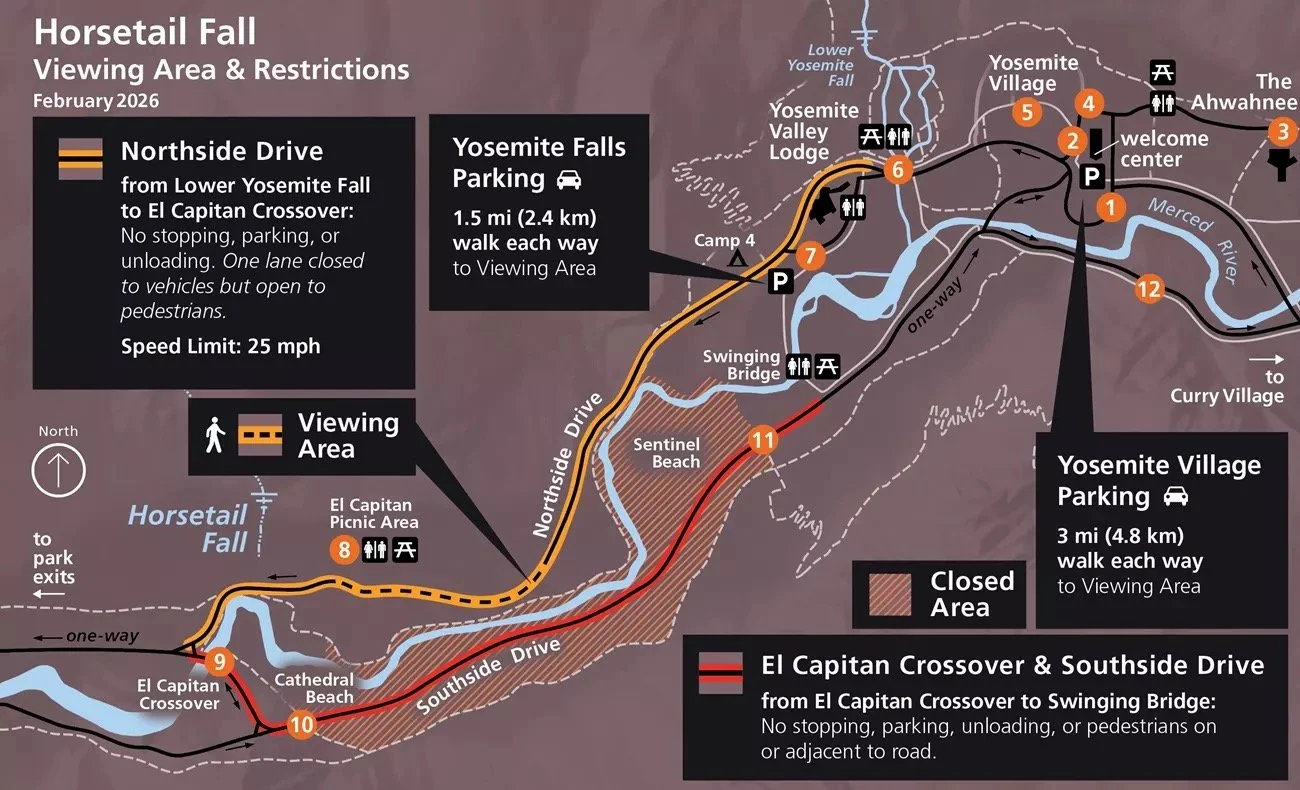
Image from the park website: https://www.nps.gov/yose/planyourvisit/horsetailfall.htm
During Firefall season, Yosemite enforces winter traffic and parking restrictions to keep everyone safe:
🚗 Road Restrictions
Northside Drive between Lower Yosemite Fall and El Capitan Crossover
No stopping, parking, or unloading
One lane may be closed to vehicles but open to pedestrians
Southside Drive & El Capitan Crossover
No stopping, parking, unloading, or pedestrian access
This means you can’t just pull over to catch Firefall — you must park in designated areas and walk in.
🚶 Typical Walking Distances
Most visitors walk in from:
Yosemite Falls Parking Area (~1.5 miles round-trip)
Yosemite Village Parking (~3 miles round-trip)
Plan to arrive at least 1–2 hours before sunset to secure your spot and get comfortable.
🏕️ Where to Stay During Firefall
Where you choose to stay can significantly impact your experience.
Inside Yosemite National Park (Best)
Staying inside the park often:
Eliminates the need for a separate day-use permit (when required)
Reduces winter driving stress
Let’s help you maximize your time in the valley
Popular options:
Curry Village (weather dependent)
These accommodations fill up quickly — especially during Firefall weeks.
Outside the Park
If lodging inside the park isn’t available:
El Portal and Mariposa are standard nearby bases
Plan extra time for morning entry and evening parking
Be prepared for winter road conditions
🛣️ Quick Proximity Snapshot of Hotels (outside the park)
Closer to West Valley / Big Oak Flat: Rush Creek Lodge, Evergreen Lodge, Firefall Ranch
Closer to Arch Rock / Highway 140: Yosemite View Lodge
South Yosemite / Mariposa Gate: Tenaya Lodge
🧭 Firefall Planning Tips I Wish I Knew Sooner
✔ Firefall is never guaranteed — even if conditions look perfect.
✔ Arrive early — sunset seekers show up well before golden hour.
✔ Wear traction devices — icy patches are common.
✔ Check weather and snow forecasts in advance.
✔ Have alternate activities planned in case Firefall doesn’t happen.
🌟 Final Thoughts
Yosemite Firefall remains one of nature’s most mesmerizing seasonal events — but it’s also one of the most misunderstood.
Whether you see the glowing waterfall or not, Yosemite in February is a remarkable adventure full of stunning landscapes, winter magic, and experiences you’ll remember long after the sunset fades.
✨ Need help planning your Yosemite Firefall adventure?
I offer personalized travel planning support so you can focus on the experience — not the logistics.
🔗 Resources
Official Yosemite National Park Firefall info:
https://www.nps.gov/yose/planyourvisit/horsetailfall.htm
Hiking & Backpacking Apparel & Gear:
https://app.rockporch.com/llink/qIvbo6F7abjFI
📦 Must-Have Gear for Yosemite Firefall
Winter Yosemite conditions can be cold, dark, and icy. These items will help you stay safe, connected, and comfortable — and many double as great gear for any outdoor adventure.
🔋 Cell Phone Power Bank
Perfect for keeping your phone charged for photos, videos, maps, and emergency use.
👉 https://a.co/d/hW5wf74
📸 Camera Tripod


Great for low-light Firefall photography and capturing long-exposure shots.
👉 https://a.co/d/a5unzqG
📱 Phone Tripod for iPhone (MagSafe with Remote)
Easy, hands-free setup for iPhone shots and reels.
👉 https://a.co/d/7f8pINf
🔦 Headlamp / Flashlight:
A headlamp makes walking back after sunset much safer. I recommend Black Diamond — you can also find headlamps in my hiking gear collection. 👉 https://a.co/d/0MI5SoJ
🧥 Layered Clothing
Yosemite evenings in February are cold. I highly recommend layering — start with good base layers and add insulation. I’ll link my Hiking & Backpacking Apparel collection at the end of this article so you can see exactly what I use and recommend: 👉
#YosemiteFirefall #Firefall2025 #YosemiteNationalPark #NatureMagic #BucketListAdventures #GratefulForLiving #AdventureAwaits #TravelTips